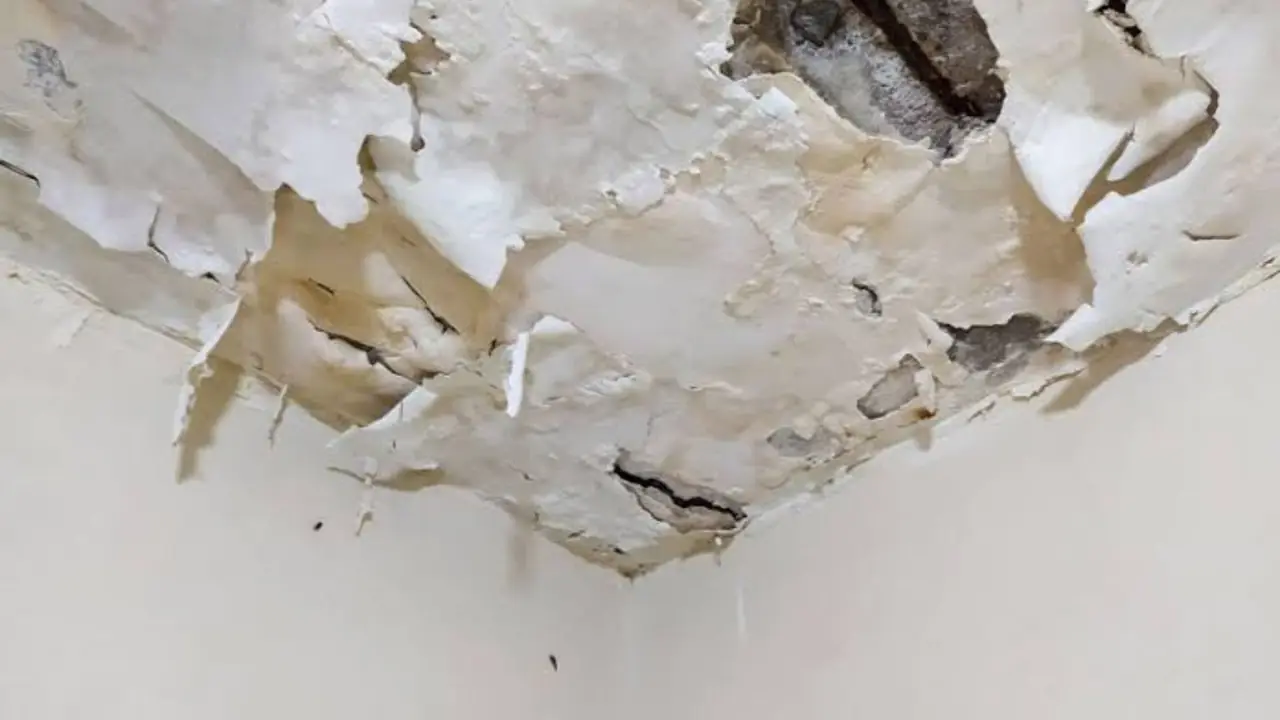
You can fix a water damaged ceiling yourself when three things are true: the leak is fully repaired, the ceiling is completely dry and the damage is a small stain or a minor surface blemish. If the ceiling sags, feels soft, smells musty or is still dripping, stop and call a professional.
The fix for a small stain is simple: confirm the area is dry, block the stain with the right primer, patch any cracks and repaint to a natural break. This guide covers each step, plus a table for deciding when to stop. For anything bigger, water damage repair is the safer route.
Step 1: make sure the leak is fixed
A stain tells you water passed through the ceiling, not that it has stopped. Before any repair, confirm the source was repaired, such as a supply line, a roof patch or an attic line. Run the fixture or wait for the next rain and watch the ceiling for a full day.
If you cannot name the source, do not repair the ceiling yet. A fresh patch over an active leak will stain again within days. Call a plumber or a roofer first, and a restoration crew if the area is wet.
Step 2: confirm the ceiling is dry
Touch alone is not enough. A pin or pinless moisture meter gives a reading you can compare with a dry section of the same ceiling. Check the stain and the area around it, since a stain can be dry while the border is still wet.
If a meter is not on hand, a hardware store sells inexpensive ones. Readings that match the dry section across two days are a good sign. If readings stay high, the ceiling is still holding moisture and needs drying first, which is water mitigation work.
| What you find | DIY or pro | Reason |
|---|---|---|
| Small tan stain, firm and dry, leak fixed | DIY | Surface blemish, primer and paint will cover it |
| Stain with a few hairline cracks, dry | DIY with care | Patch compound and primer handle it |
| Stain that is still damp or growing | Pro | Moisture is active and needs drying first |
| Soft, sagging or bulging panel | Pro | Wet drywall can fall and needs safe removal |
| Peeling paint with dark spots | Pro, then see mold rule below | Possible mold needs a closer look |
| Stain is larger than a few feet across | Pro | A bigger area often hides wet insulation above |
Step 3: block the stain and patch the surface
Lightly sand any loose paint or peeling edges. Wipe the ceiling with a damp cloth and let it dry. Fill hairline cracks with joint compound, sand smooth and wipe away dust. If the paper surface is torn, cover it with a thin coat of primer before applying compound.
Use a stain-blocking primer, not regular wall paint. Water stains contain minerals and tannins that bleed through ordinary paint, so a regular coat can show the stain again within a few days. Two coats of primer on a dark stain is common.
Tools and materials for a small ceiling fix
- A moisture meter, to confirm the ceiling is dry before you start.
- Stain-blocking primer, plus a roller and an angled brush.
- Joint compound and a putty knife for cracks.
- Fine sanding sponge and a dust mask.
- Drop cloths, a ladder and safety glasses. Never work under a sagging panel.
Step 4: repaint to a natural break
Ceiling paint is unforgiving. A freshly painted spot on an older ceiling shows under side light, so paint the whole ceiling to the nearest wall, or at least to a natural line like a light fixture or a beam. Use the same sheen as the existing ceiling, usually flat.
Allow the primer to dry fully, then apply two thin coats of paint, letting each dry in between. Rolling in one direction, then crossing at right angles, hides roller lines. If the stain returns after painting, the source may not be fully fixed.
Not sure the leak is really gone or the ceiling is dry? Call the 24/7 line and ask for an assessment.
☎ (817) 623-9267When to stop and call a professional
Stop if the ceiling sags, bulges or feels soft. Stop if there is dark spotting, a musty smell or a stain that grows after the leak was fixed. Stop if the stain is large, since a large stain suggests wet insulation above. And stop if the stain appeared after a sewage or dirty water leak.
A professional crew checks the area above the ceiling as well as below it. They can dry insulation and framing that cannot be seen from the room. For an active or sagging ceiling, the right call is emergency water removal, not paint.
Cost factors if you hire a pro
The price of a ceiling repair depends on a few things: the size of the area, whether insulation above needs replacing, how hard the texture is to match, access to the attic and how much of the ceiling needs repainting. A real number needs someone to look at it.
If your ceiling damage came from a sudden leak, check your policy. The Texas Department of Insurance says most policies cover sudden and accidental water damage and generally exclude gradual leaks.
Flower Mound note: the 25 square foot mold rule
The Texas Department of Licensing and Regulation says visible mold under 25 contiguous square feet can generally be cleaned by an unlicensed owner or maintenance staff. A licensed mold remediation contractor must follow the rules on any size job.
For a ceiling, that gives a simple decision rule. A small spot on a ceiling you have confirmed dry, with the cause fixed, is a homeowner decision. Anything larger, or any spot you cannot explain, belongs with a licensed professional. See mold remediation for the next step.
If you are in Argyle or Lewisville, the same 24/7 line can send a crew to assess a ceiling before you pick up a paint roller.
Frequently Asked Questions
Yes, but only after the leak is fixed and the ceiling is dry. Use stain-blocking primer first, then paint. Regular paint alone lets the stain bleed back through.
Use a moisture meter and compare readings with a dry part of the same ceiling. Check the stain and the border around it, and repeat the reading after a day or two.
Usually the source is still leaking, the ceiling was still damp or regular paint was used without a stain blocker. Fix the source, confirm it is dry and prime again.
Stop if the ceiling sags, feels soft, smells musty, is still damp or shows dark spots. A large stain can also signal wet insulation above, which needs professional drying.
TDLR says visible mold under 25 contiguous square feet can generally be cleaned by an owner. Larger areas or unexplained spots should go to a licensed professional.
A small dry stain can be a weekend project. A wet or sagging ceiling cannot. If you are unsure which you have in Flower Mound, call the 24/7 line and a dispatcher can help you decide.